


Cold plunges, also known as cold water immersion or cold water therapy, involve submerging the body in cold water for a few minutes.
There has been a lot of hype around cold plunges in the last few years. Famous sports people, influencers, and celebrities have incorporated cold plunges into their routines for their health benefits.
However, with so much contradictory information out there, it can be difficult to understand the benefits of cold water immersion.
That’s why, to uncover these benefits, we spoke with Alan Silvestri, who’s been doing cold plunging for years now.
He is a Digital PR consultant for a Canada-based marketing agency Powered By Search. He is also a certified Natural Lifestyle Coach (Tony Riddle program) and Barefoot Movement Coach (Vivo Barefoot), and he runs the One of Us Community, focusing on men’s holistic wellness.
Our research, combined with Alan’s insights, provides a comprehensive overview of the key benefits of cold plunges.
Let’s get started.
Key Benefits of Cold Plunges
The number of scientific studies about the benefits of cold plunges is on the rise, and existing evidence clearly demonstrates how they can help.
Here’s what we know so far.
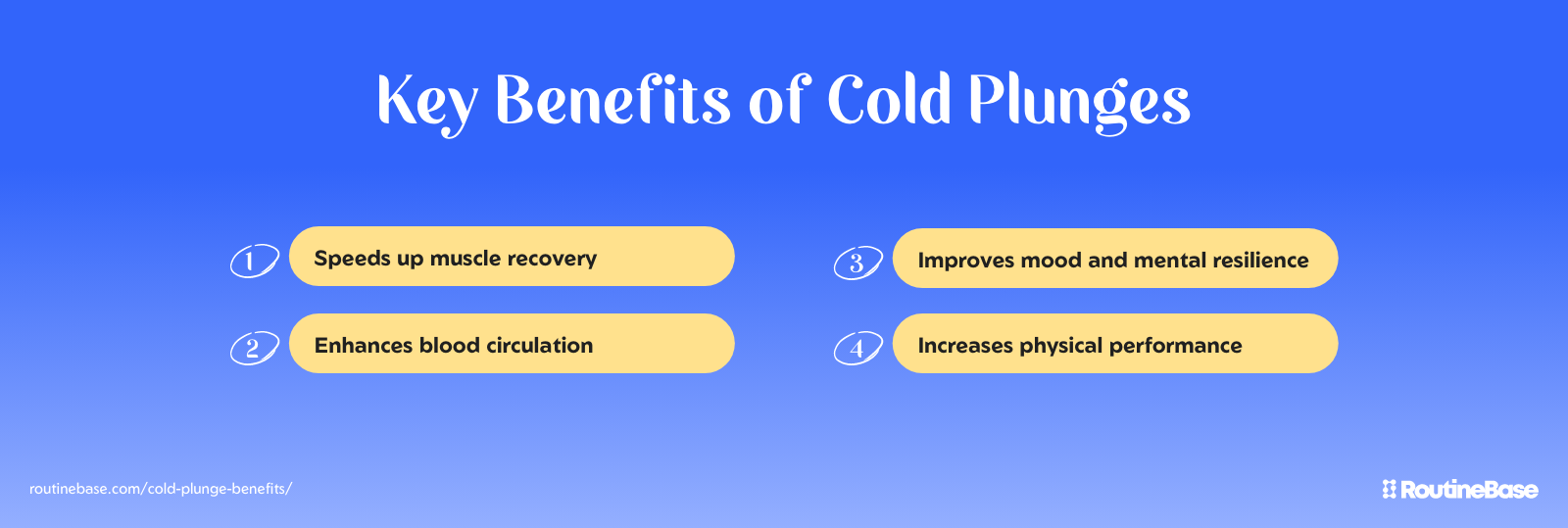
Speeds up muscle recovery
According to a study that investigated the physiological stress experienced by athletes in tournament scenarios, cold water immersion improved sprint recovery and reduced muscle-damage markers and muscle soreness. For anyone training with real volume, the way you set up a post-workout ice bath, and when you use it relative to lifting, both affect how much of that recovery benefit you actually keep.
Alan also agrees that cold plunges speed up recovery:
Enhances blood circulation
Like saunas, cold water immersion, a type of cryotherapy, is believed to improve blood circulation by constricting and dilating blood vessels.
“It’s been shown to have some effect on improving the immune system, like blood flow, circulation, all these things,” says Alan.
Improves mood and mental resilience
This benefit is Alan’s favorite. He revealed that the primary reason he does cold exposure is for its mental health benefits.
“The key thing is, essentially, I see cold immersion as a practice to improve mental and physical resilience.
When you get cold, your whole body goes into a state of stress. You’re completely tense. I like to see it as a way of calming myself down in the midst of all of this stress, and then you can apply the same technique in your work or personal life to improve wellbeing,” says Alan.
A study showed that cold exposure can increase dopamine levels in the short term, improving mood and reducing anxiety.
Increases physical performance
Alan runs a lot and does some strength exercises two or three times a week. He revealed that cold showers and plunges improve his running performance and his overall body energy.
“Even just taking cold showers for like three to five minutes helps my running performance. I noticed that I was able to run more often for longer, and I didn’t get injured as well since I started doing the cold showers and the river on the weekend.
Obviously, cold showers are different because the water is not even across the whole body, and then it’s warmer, definitely, than even the river, for example.
If you can only take cold showers, it can help to take them for longer, at least three to five minutes.
You feel lighter once you get out of the cold and more active, but also all the mental benefits like the mood and the energy. You get the compounding effects because if you feel better, if you have more energy, then you’re going to want to exercise more, and it’s sort of like a flywheel effect. So, I would say adding cold plunges to your physical activity routine can be very effective.”
Risks and Side Effects of Cold Plunging
Despite its important health benefits, cold plunging has some side effects and risks you should consider.

Hypothermia
A common risk of cold plunging is hypothermia, which happens when your body temperature drops too low.
Symptoms of hypothermia include intense shivering, confusion, and weak muscles. If you experience these symptoms during cold plunges, immediately get out of the cold plunge tub.
Alan also advises:
Afterdrop
Afterdrop is another side effect of cold plunges, and Alan explains how it happens and how to manage it:
“This is something that people should be really careful about. It’s called afterdrop. So basically, the cold blood in your limbs, like your extremities, flows back into your core.
When you get into the cold, all of your blood goes into the core to protect the vital organs, so that’s where most of the heat is. This is also why your hands and feet are going to be really cold because blood has flown into the core.
So what happens then with the afterdrop is once you get out, you’re going to feel very nice for a minute or two, but then what happens is that the cold blood that was in the extremities starts flowing back into the core and you can feel even colder sometimes than you were in the water.”
Cardiovascular stress
Cold plunging can place significant stress on the cardiovascular system, especially for people with pre-existing heart conditions.
The sudden drop in body temperature causes blood vessels to constrict, which raises blood pressure and increases the risk of heart attack or stroke.
These potential risks and side effects of cold plunging should always be considered regardless of your current health condition.
Talking to your doctor before starting cold plunges can help you understand the risks and determine if it’s a safe practice for you.
How to Do a Cold Plunge
Since he’s been practicing cold plunging for many years now, Alan has some useful tips to share for those beginning this practice.
These guidelines and techniques will help you safely and effectively perform a cold plunge.

Preparation
The success or failure of your cold plunge practice depends mainly on what you do before jumping into the water.
Here are some practical tips to help you prepare for cold plunging:
- Do 2-3 minutes of deep breathing through your nose. Aim to expand your exhale to get into the parasympathetic mode, which decreases your heart rate. This will help you combat hyperventilation caused by cold shock once you get into the water.
- If you like visualizations, try picturing how you want to feel in the water. This will help you set clear intentions. “Something that I’ve seen people do and that I’ve done a couple of times is visualization, actually visualizing yourself going through the cold and trying to feel the sensation before you go in,” he reveals.
- Do some exercises to warm up your body before entering the ice water. “So make sure that you warm up the whole body, especially the bigger muscles in the legs and the core before you go in. There’s a warm-up practice, the horse stance, where you get down in a kind of […] a squat position, which helps keep the main muscles, the quads in the legs […] engaged as well as moving the whole core. What it does is to produce heat so that then you can use that heat to make it easier to be in the core while in the water,” Alan says.
Breath control
According to Alan, breathwork is the secret to successful cold plunging.
“One problem might be if you can’t control your breathing and you keep breathing in, which can bring you into hyperventilation. What you should be doing instead is focusing on breathing out and making the exhale longer than the inhale. When we breathe in, the fight-or-flight nervous system is activated. When we breathe out, we activate the parasympathetic nervous system.
Parasympathetic is the rest-and-digest state, which is when we are, for example, after you have had a meal, that is the state you are in, so your body is completely calm, and you feel safe because you have food or whatever.”
Move your body after getting out
When you immerse yourself in a low water temperature, the blood from your extremities goes to the core to supply the vital organs and protect them from the cold.
That’s why, after you get out of the water, it’s essential to move your body to help restore warmth and improve circulation.
You can try gentle exercises like light jogging, stretching, or dynamic movements to gradually raise your body temperature.
Other Cold Plunging Tips
We have some extra tips from Alan, who’s got years of experience doing cold plunges.
Below, he discusses some challenges, best practices for beginners, and who should think twice before starting cold plunging.
What was a big challenge you faced with cold plunges?
“I say the biggest challenge was for me that I have this thing called Raynaud’s syndrome, which has something to do with blood circulation in the hands, mainly in the limbs. So what happens is when I get cold, [blood in] […] my fingers essentially stops flowing. That’s been a challenge because I can’t feel my hands.
So, when I make cold plunges, I just keep my hands out, and that helps a little bit.
That’s a small price to pay. I can’t think of many other challenges.”
What practical advice would you give to someone new or about to start cold plunging?
“I’ll also say safety first. Never go into dangerous icy water and make sure that if you go into a river like I do, it’s safe.
Something that can be helpful is to aim for discomfort instead of danger. So, you want some form of discomfort that will make you stronger or healthier in the long run. But don’t look for danger or do anything crazy or weird just to do it.”
Would you recommend this to a person who deals with stress or burnout?
“I would say it depends on how strongly burned out they are. If it’s something that’s not chronic or very bad, then I would probably recommend it because what you do is called hormetic stress. This is a controlled stress environment that trains you to understand that you have the power to deal with the stressor instead of just being a victim of whatever is happening to you.
I do think that you need to be in a state where you can understand, you know, that’s something that you control because if you’re just in this spiral of burnout and everything, yeah, that’s probably not very good for you.”
Do you have any other advice for our readers?
Wrapping Up
Despite the hype and the often conflicting information available on cold plunges, our research and insights from an experienced cold-plunger give you a clear understanding of the practice.
However, remember to always check with your doctor about whether it’s safe for you to take cold plunges.
If you want to learn more about famous people’s routines and how to create consistent daily habits, check out our article base.


FAQs
Like any new habit, include cold plunges into your daily routine by starting with short sessions and slowly increasing the time as your body adapts.
How frequently you do cold plunges depends on your tolerance and goals. It’s best to start small, once or twice a week, and then gradually increase the frequency.
Cold water exposure might not be safe for everyone. People with certain medical conditions like heart disease or high blood pressure might not be safe practicing cold plunges. It’s best to consult a healthcare professional before starting.
Even two or three minutes can help you experience cold plunge benefits. As you build tolerance, you can gradually increase the duration. For many, staying in for up to ten minutes can improve workout recovery, circulation, and mental resilience.
You Might Also Like
Discover how to build a daily routine from an entrepreneur who already has. Learn his best practices for making your own routine and changing your life.
See how someone already tracks their daily routines, how they created a tracker to best suit their needs, and get access to that same daily routine template.
We tested 8 of the best habit tracker apps over several weeks. Here’s what actually works, what doesn’t, and which one you should use.

