Uncategorized Archives - Page 2 of 3 - RoutineBase

Dua Lipa’s Workout, Skincare & Sleep Routine

If you’ve seen Dua Lipa light up a stage for two straight hours, it’s pretty clear she doesn’t just wing her days.

With touring, recording, interviews, and constant travel, she sticks to a routine that’s flexible but still keeps her feeling strong, glowing, and grounded. She’s also not extreme about it; she works out, looks after her skin, and takes rest seriously, but she still enjoys her food and lives like a normal person.

Here’s what her days usually look like.

Morning: wake-up, hydrate, move

Dua Lipa has said that mornings are her best chance to set the tone before the day gets hectic.

When she’s not on a red-eye schedule, she tends to wake up in a normal late-morning window for performers – often around 8-10 a.m. – and starts with hydration and something gentle to get her body online.

Touring life can mean different time zones weekly, so rather than a “5 a.m. grind,” she builds a more sustainable and flexible morning routine.

However, the cornerstone is movement. She’s known for mixing training styles depending on where she is in a work cycle. In interviews and in trainer breakdowns, her go-to includes:

  • Pilates (especially reformer Pilates) for core strength, posture, and long-line control that translates directly to dancing on stage
  • Yoga for mobility, balance, and mental decompression—she uses it as both workout and moving meditation.
  • Strength and conditioning / HIIT to stay performance-ready, often in full-body circuits that build endurance without bulking her down.
  • Dance rehearsals as cardio, which is basically sport-specific training for a pop star.

When she’s prepping for tour, the intensity rises. Recent behind-the-scenes clips show her doing advanced yoga flows, handstands, balance work, agility drills, and cooldown recovery sessions like stretching and cold therapy.

Post-workout: shower & skincare

After training, she cleans up and shifts into skincare mode.

Dua’s skin routine is shaped by a very real touring problem: heavy stage makeup plus sweat used to trigger breakouts when she was younger.

These days, she’s almost religious about cleansing first, then layering hydration and treatment. In her Vogue “Beauty Secrets” features, she describes double-cleansing (often starting with micellar water) to remove makeup and grime, then following with a gentle cleanser.

Her routine tends to look like this:

  • Remove makeup / SPF thoroughly (micellar water or oil-based first cleanse).
  • Gentle second cleanse to reset skin without stripping it.
  • Serums for glow and calm—she’s mentioned antioxidant/soothing serums that hold up under travel stress.
  • Moisturizer to protect barrier (especially important for flights and dry arenas).
  • SPF in the daytime—a non-negotiable for preventing hyperpigmentation and keeping skin even.

She’s also pragmatic: drugstore finds and high-end products coexist on her shelf. Her philosophy is less “15 steps because celebrity,” more “clean, hydrate, protect.”

Breakfast is usually simple, protein-forward, and flexible. She doesn’t publicly follow a strict diet, but profiles of her routine note she fuels for training: eggs, yogurt, fruit, oats, smoothies-quick options that travel well.

She’s consistent about eating something real rather than skipping meals.

Midday: work blocks and steady eating

Late morning through afternoon is typically rehearsal, studio, interviews, or brand meetings. She’s also the founder of Service95, so some portion of her day is “office brain,” not just performer brain.

Food-wise, she aims for balance over restriction. The pattern is closer to Mediterranean-style eating: lean proteins, vegetables, carbs that support energy, and enough fats to keep her satisfied. She’s been open that she loves to eat and doesn’t label foods as “good” or “bad,” which matters because high-output careers need sustainability.

Evening: showtime energy, wind-down rituals

If she’s performing, evening becomes a focused ramp-up: glam, vocal warm-ups, choreography review, and mental prep. Otherwise, evenings are where she lets herself be social, read, cook, or go out-she’s famously a great recommender of books and culture through Service95, which hints at how she actually unwinds.

Night skincare mirrors morning but deeper. She removes makeup carefully, cleanses again, hydrates, and treats her skin to recovery. Touring can mean sleeping in hotel air-con dryness, so moisturizing and barrier support are key.

Sleep and Recovery

Dua’s schedule isn’t perfectly “sleep-hygiene influencer.” Some nights end at 2 a.m. with travel or a post-show adrenaline spike. But she prioritizes recovery wherever she can: solid overnight sleep when possible, and naps during heavy training/tour periods.

Her team has emphasized that rest is part of her performance prep, not an afterthought.

At the end of the day, Dua Lipa’s “daily routine” isn’t a single fixed schedule. Pilates and yoga keep her body stage-ready, strength work gives her stamina, skincare stays simple but consistent, food supports energy without guilt, and rest is treated like training.

Jennifer Aniston’s Workout Plan: What She Really Does to Stay Fit & Strong

Jennifer Aniston’s fitness has evolved from hours of hard cardio and boxing to a low-impact, strength-focused approach that she says has transformed her body.

What we did was do a breakdown of her current routine, how she eats in a day, recovery habits, and a practical way to follow her blueprint.

Without further ado, let’s get started.

Jennifer Aniston’s Current Fitness Philosophy

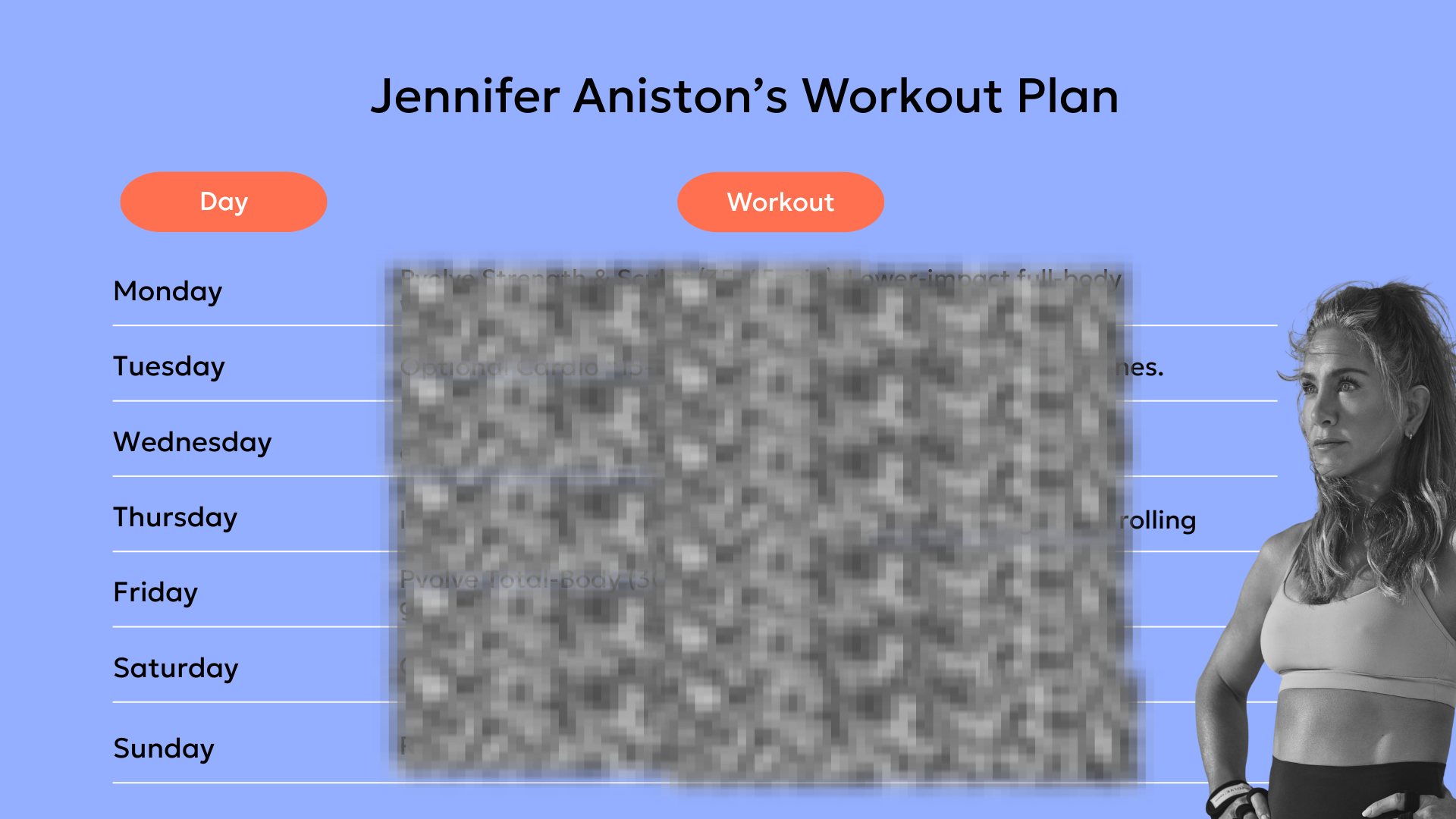
Jennifer Aniston’s workout routine centers on low-impact strength and mobility training with Pvolve, a resistance-based method she credits for transforming her body. Instead of pushing herself to exhaustion, she focuses on precise, joint-friendly movements that build lean muscle and improve posture.

Aniston trains about three to four days per week, keeping her sessions between 20 and 45 minutes. On other days, she enjoys hiking or Pilates to stay active without overdoing it.

Her fitness philosophy is simple: consistency over intensity. She’s moved away from the “no pain, no gain” mentality, preferring to listen to her body and adjust her effort based on energy levels.

Jennifer Aniston’s Workout Routine

The Core Method (Pvolve)

Pvolve uses bands, a p.ball, gliders, light weights, and tools like the slant board and P.3 Trainer for small, controlled movements that hit “teeny little muscles” for strength, stability, and mobility.

How she structures it

  • Frequency: ~3–4x/week; 20–45 minutes scales up or down with energy and schedule.
  • Effort: She’ll do just 10–20 minutes on low-motivation days; it “meets you where you’re at.”

Past & optional add-ons she still likes

  • Pilates and hiking to mix things up.
  • Her old “15-15-15” cardio (15 min bike + 15 min elliptical + 15 min treadmill) remains a simple option if you enjoy steady-state cardio.

What Jennifer Aniston Eats in a Day

Morning

  • First thing: room-temperature water + ARMRA colostrum + whole lemon juice; in colder months she adds ginger and a little Manuka honey.
  • Coffee habits: She’s long been known to add collagen peptides to her coffee/smoothies; she’s shared details about “coffeemaxxing” (collagen + milk, etc.) in recent interviews.

Breakfast (when she eats it)

  • Often avocado + eggs and/or a protein smoothie with bananas, berries, greens; may add maca, cinnamon, or collagen.
  • She has used intermittent fasting (16:8) in the past—liquids only in the morning—though her approach has softened over time.

Lunch

Simple protein + vegetables/salad: “pretty basic,” focusing on quality ingredients and balance.

Snacks

Apple with almond butter or nuts, raw veggies, or hard-boiled eggs kept on hand.

Dinner

Similar protein + vegetables; she’ll do a lettuce-wrapped chicken burger or something equally straightforward.

Recovery, Motivation & Wellness Habits

Jennifer Aniston takes recovery as seriously as her workouts. She regularly uses infrared saunas and Epsom-salt baths to relax her muscles, along with foam rolling and gua sha to release tension. These simple habits keep her body mobile and prevent soreness.

She follows a “little and often” approach, even on low-energy days, she moves for at least ten minutes to stay consistent. This mindset helps her avoid burnout while still feeling strong and centered.

Aniston also tracks her sleep and recovery with an Oura Ring, adjusting her workouts based on how her body feels. It’s a smart, sustainable approach that balances effort with rest, one that keeps her fit, grounded, and glowing well into her 50s.


10 Science-Backed Ways to Improve Focus & Boost Mental Performance

In a world of constant notifications, multitasking, and endless to-do lists, maintaining focus has become harder than ever.

Over the past two decades, neuroscientists and psychologists have uncovered practical ways to enhance attention, sharpen mental clarity, and reduce distractions. 

From strategic nutrition and exercise to sleep optimization and targeted nootropics, small, evidence-based habits can significantly improve how long and how well you can focus!

Way #1: Use Nicotine

Nicotine has been vilified for decades because of its association with smoking and vaping. 

However, did you know that low doses of nicotine are well known to enhance brain function by attaching to certain receptors that release acetylcholine, dopamine, and norepinephrine (chemicals that help with alertness, attention, and motivation)? 

In fact, as crazy as it may sound, many studies have found that low doses of nicotine can improve short-term focus, attention, and memory; things that are much-needed in our daily lives.

Should you be vaping or smoking nicotine to get these effects? Absolutely not. The amount of nicotine in these products is very high + you are also getting other additives directly into your lungs that are harmful to your health. 

In our opinion, the best and safest way to take it is to buccal it with a product like Blue Cannatine by Troscriptions.

Blue Cannatine only has 1mg of nicotine and, because buccal troches are slow release in the mouth, it will enhance your cognition, your memory, and clear brain fog, without any risks. 

It will also:

  • Unleash your productivity
  • Give you laser-sharp focus
  • Improve your memory

And allow you to unlock new realms of possibility!

Find Blue Cannatine here and use code ROUTINEBASE at checkout for 10% off your first order

Way #2: Exercise Regularly

Physical activity is one of the most powerful tools for sharpening attention and mental clarity. 

In fact, research from Harvard Medical School has shown that regular aerobic exercise increases the size of the hippocampus (which is a brain region crucial for memory and learning). 

Exercise also boosts:

  • Dopamine
  • Norepinephrine
  • Serotonin

All of which are neurotransmitters that help regulate attention and motivation.

Even short bursts of movement can help. A brisk 10–15 minute walk can temporarily enhance concentration and working memory. 

Over time, consistent exercise improves baseline cognitive performance, helping you focus better throughout the day!

The bottom line:  Even simple movements, like stretching between work sessions, can boost blood flow and re-energize your brain.

Way #3: Prioritize Quality Sleep

Lack of sleep is one of the fastest ways to sabotage focus. 

During deep sleep, the brain consolidates memories, clears out toxins (via the glymphatic system), and restores neurotransmitter balance.

Chronic sleep deprivation, on the other hand, decreases activity in the prefrontal cortex, which is the area responsible for decision-making and attention.

Actually, according to Nature Neuroscience,  even a single night of poor sleep can reduce alertness and reaction time by up to 32%.

Amazing, right?

The bottom line: Adults should aim for 7-9 hours of sleep per night. Maintain consistent sleep and wake times, keep your bedroom dark and cool, and avoid blue light exposure from screens at least one hour before bed.

Way #4: Use Caffeine (Strategically)

Caffeine has many critics out there, but the truth is it isn’t bad for you (assuming a reasonable daily intake).

After all, it remains one of the most studied and effective cognitive enhancers. It works by blocking adenosine receptors, reducing fatigue and increasing alertness.

Yes, excessive caffeine or poor timing can lead to jitteriness and disrupt sleep –  ultimately harming our  focus – which is why it’s vital that we find the sweet spot. 

According to research, the sweet spot is about 1-3 mg per kilogram of body weight (roughly 80-200 mg for most adults).

Of course, caffeine doesn’t necessarily have to come directly through coffee. You can find it as an ingredient in several supplements and products, such as Blue Cannatine, which contains 50mg of caffeine.

This is the perfect amount to boost your alertness and reduce fatigue, providing you with that much-needed energy to get through your day. 

The bottom line: Use caffeine strategically, in the morning or early afternoon, and avoid late-day consumption to protect sleep quality.

Way #5: Practice Cold Exposure or Deep Breathing

Cold exposure and deep breathing are emerging as powerful tools to sharpen attention by stimulating the body’s stress-regulation systems. 

That’s because cold showers or brief immersions in cold water trigger a release of norepinephrine, a neurotransmitter linked to alertness and focus.

Similarly, deep breathing techniques such as box breathing or the Wim Hof method activate the parasympathetic nervous system, improving oxygen flow and mental calmness.

The bottom line: You can even start with 30 seconds of cold water at the end of your shower or 3-5 minutes of focused deep breathing before work.

Way #6: Eat Brain-Boosting Foods

They say that you are what you eat, right?

What you eat directly affects your brain’s ability to focus. Diets rich in omega-3 fatty acids, antioxidants, and polyphenols support neuronal communication and reduce inflammation. 

Think of foods like fatty fish, blueberries, walnuts, and dark leafy greens; all are linked to better cognitive performance.

The bottom line: Avoid heavy, processed meals that spike blood sugar and cause mid-afternoon “brain fog”.

Way #7: Train Your Brain with Focused Activities

Just like physical muscles, your “attention muscle” strengthens with training. 

Activities that demand sustained focus (e.g. meditation, reading, playing a musical instrument, or puzzle-solving) have been shown to increase gray matter density in attention-related brain areas.

Meditation, in particular, has strong evidence: a 2013 research from Yale shows that mindfulness meditation can increase activity in the anterior cingulate cortex (ACC), improving your ability to resist distractions.

The bottom line: Practice 10-15 minutes of mindfulness or other mentally engaging tasks daily. Even short but consistent sessions yield long-term improvements.

Way #8: Set Clear, Small Goals

Vague intentions like “focus more” are hard to act on, while specific, achievable goals create a dopamine-driven feedback loop that reinforces concentration.

The SMART framework (Specific, Measurable, Achievable, Relevant, Time-bound) helps break complex tasks into smaller, trackable milestones. This approach not only reduces cognitive overload but also provides psychological rewards as you make progress.

The bottom line: Define exactly what “focused work” means for you (e.g. to write 500 words in 30 minutes) and celebrate small wins to keep motivation high.

Way #9: Stay Hydrated

Even mild dehydration – as little as 1-2% loss of body water – can impair attention, short-term memory, and mood. 

Studies have shown that hydration plays a vital role in maintaining cognitive performance, especially during demanding mental tasks.

Because the brain is composed of about 75% water, fluid balance directly affects neural function and communication. Makes sense, right?

The bottom line: Aim for 2-3 liters of water per day, depending on your activity level and climate. You can also boost hydration through fruits and vegetables

Way #10: Use Mental Visualization

Visualization is a mental training technique that enhances focus and goal-directed behavior by priming your brain’s reticular activating system (RAS); the network that filters what information you pay attention to.

Athletes and high performers often use visualization to mentally rehearse actions and outcomes, leading to improved real-world execution. 

The bottom line: Spend a few minutes each morning visualizing your ideal work session, the tasks you’ll complete and how you’ll feel when done

Let’s wrap things up with some final words.  

Conclusion

Improving your focus isn’t about finding a single “hack”, but about building small, consistent habits that strengthen your brain’s ability to stay on task. 

Exercise, quality sleep, hydration, nutrition, and mindful goal-setting all play vital roles in keeping your mind clear and energized.

And of course, a little extra help from products and supplements can also work wonders!

The 7 Best Fitness & Wellness Newsletters to Level Up Your Health Game

The internet is overflowing with fitness advice, wellness trends, and “biohacks” that promise to change your life overnight.

But let’s be honest… most of it’s either repetitive or impossible to apply in real life. That’s where a great newsletter makes all the difference.

That’s why we gathered the 7 best fitness and wellness newsletters out there (in our opinion). Whether you’re trying to train smarter, eat better, recover faster, or simply feel good in your body, these newsletters offer the perfect mix of knowledge and inspiration.

Let’s get started.

Newsletter #1: Arnold’s Pump Club

Arnold’s Pump Club is a daily, habit-first newsletter blending fitness, nutrition, and mindset in an ultra-accessible voice. The focus is on small, doable wins: simple workouts, 5-minute food fixes, and mental reframes delivered like a pep talk from a supportive coach.

And yes, you guessed it right, it’s by Arnold Schwarzenegger.

While it nods to research, the real value is practicality and consistency—ideas you can try the same day without special equipment or advanced knowledge. Expect a friendly tone, community vibes, and frequent reminders that progress beats perfection.

What’s unique about it: You’ll learn how to turn science-ish advice into everyday habits, weekly toolkits you can implement in minutes, and mindset cues to keep momentum.

What we like about it: It’s short, motivating, and hyper-actionable; a fantastic adherence booster.

Newsletter #2: Routine Design Fridays

Shameless plug, but at number two we have our own newsletter: Routine Design Fridays.

Every Friday, our all-in-one fitness and wellness newsletter lands in your inbox with one goal: to help you think, train, and live like the world’s top performers without needing a personal trainer, nutritionist, or life coach.

Inside each issue you’ll find:

  • Routine hacks: inspired by the daily habits of elite athletes, founders, and creatives so you can build structure and momentum like a pro.
  • Nutritional hacks that you’ve never heard before, easy to integrate into your lifestyle.
  • Exclusive resources such as daily routines, morning rituals, workout templates, and recovery guides from high-achievers across industries.
  • Science-backed facts about how your body and mind really work, simplified so you can take action right away.

All with the goal of helping ordinary people become extraordinary. Each edition helps you personalize these insights into a plan that fits your lifestyle

Don’t hesitate to subscribe and join thousands of fitness & wellness enthusiasts in the form below:

What’s unique about it: You’ll get the inside scoop of the daily fitness routines of the world’s best of the best, with practical tips, plans and insights that you can tailor and apply to your own routine.

Newsletter #3: Peter Attia

Peter Attia’s newsletter is a deep dive into longevity, metabolic health, and performance medicine with clinical rigor.

The writing assumes curiosity and a tolerance for complexity; concepts build over time and often link back to longer essays or podcast episodes. If you want “why” and “how” with tradeoffs and uncertainty clearly labeled, this scratches that itch.

What’s unique about it: How to prioritize the “big rocks” of longevity, interpret biomarkers, and structure training for the next decade, not just the next race.

What we like (and don’t): Evidence-forward and integrative. Dense at times; fullest depth often pairs best with Peter Attia’s podcast or paid content.

Newsletter #4: Huberman Lab – Neural Network

Huberman’s newsletter distills podcast episodes and papers into stepwise “toolkits”; light exposure timing, caffeine dosing, breathing protocols, progressive training levers. Plus mechanisms so you understand why a tool might work.

The cadence can be dense, but if you like interventions with plausible biological underpinnings, Huberman’s newsletter a treasure.

What’s unique about it: Protocol stacks (e.g., sleep, jet lag, learning) and how to iterate them based on goals, schedule, and tolerance.

What we like (and don’t): Actionable and well-referenced. Volume can be high; some tools invite self-experimentation that won’t fit everyone.

Newsletter #5: FoundMyFitness

This newsletter by Dr. Rhonda Patrick gives emphasis on micronutrients, inflammation, thermal stress (sauna/cold), circadian rhythm, and gene-lifestyle interactions. Expect meticulous references and mechanistic explanations that connect diet and environment to aging pathways.

Content often explores dosage ranges, safety, and who may benefit most, along with graphics and summaries that help non-scientists keep up.

What’s unique about it: Nuanced takes on vitamin D, omega-3s, sauna frequency, fasting windows, and light exposure, complete with caveats.

What we like (and don’t): Rigorous and thorough. Can be heavy reading for beginners; fewer “quick wins” than habit-first newsletters.

Newsletter #6: BarBend Newsletter

BarBend is about strength sports and practical lifting for the broader fitness crowd. Expect quick news hits (powerlifting, weightlifting, strongman), form advice, exercise libraries, and equipment guidance.

The cadence is frequent and approachable: short reads that help you pick an accessory movement, tweak a cue, explore effective mobility exercises, or understand a competition result without diving into academic papers.

It’s great for lifters who want to stay engaged without committing to monthly research reviews.

What’s unique about it: Technique nuggets, program ideas, and timely strength-world updates in a digestible format.

What we like (and don’t): Consistent with valuable tips. Breadth over depth; won’t replace a formal programming resource.

Newsletter #7: mindbodygreen

Mindbodygreen offers broad wellness content across sleep, movement, nutrition, healthy aging, mental well-being, and lifestyle design.

The value is curation: quick, topical pieces with expert quotes, product roundups, and everyday habit suggestions. It blends mainstream wellness with occasional deep dives, so you can skim daily and bookmark the deeper guides.

Quality varies by writer and topic, but the breadth helps general readers keep a pulse on trends without living on health Twitter.

What’s unique about it: Cross-discipline best practices you can slot into a busy life-sleep hygiene, simple workouts, and food swaps.

What we like (and don’t): Wide appeal and frequent updates. Variable depth; not ideal if you want tightly focused performance content.

Arnold Schwarzenegger’s 2026 Diet, Supplements & Workout Plan

Arnold Schwarzenegger won the Mr. Olympia title seven times between 1970 and 1980, but he still trains  – almost – like he used to. After all, he’s almost 80 years old!

He works out every day but makes sure that his once heavy workouts are now joint-friendly and his training is focused on longevity.

A hallmark of his routine is active commuting. He frequently bikes to Gold’s Gym Venice before lifting, which he’s publicly shared.

Coming up, we’ll dive deep into the daily workout plan of Arnold Schwarzenegger, as well as what he eats in a day and what kind of supplements he takes to stay fit and healthy.

What Arnold Eats in a Day

Arnold has been quite transparent about his daily diet in his own daily newsletter, Arnold’s Pump Club.

He frames eating as simple, routine, and mostly plant-forward (roughly ~70% plant-based), prioritizing whole foods over shakes.

In a typical day:

  • Breakfast (after training): Oatmeal or Greek yogurt with granola
  • Lunch: A big salad, sometimes with a veggie burger, or salmon/chicken, or a scramble/omelet for added protein.
  • Dinner: Soup (he likes legume-rich options such as chickpea-based soups) and often a light salad; he aims to eat light at night.

He has also said he cut back on protein shakes, leaning harder into whole-food protein sources for heart and joint health (he still enjoys meat occasionally but keeps it moderate).

Supplements Arnold Schwarzenegger Takes

Arnold takes far fewer supplement than he uses to in his youth. He uses fewer shakes than in years past and focuses on whole foods first, then supplements as needed for convenience and coverage.

Actually, he believes that protein is the only supplements that constantly delivers. And while protein can come from any food source, protein shakes have been proven across more than 40 years of research.

However, during his competitive bodybuilding years he used a range of mainstream nutritional supplements, such as:

  • Protein powder (obviously)
  • Multivitamins and minerals: to ensure micronutrient sufficiency given high metabolic demands and heavy training.
  • Amino-acids: used for recovery and anti-catabolism, particularly surrounding workouts.
  • Creatine
  • Liver tablets: were popular as a rich source of iron, B vitamins and protein.
  • Occasional stimulants like caffeine: used pre-workout for more focus and energy

It’s worth keeping in mind that the supplement industry in the 1970s was less regulated and less diverse, so there weren’t many choices. Supplements were mainly used to fill gaps, add calories, and aid recovery; not as substitutes for training, sleep, or food quality.

Nowadays, the industry has vastly changed and supplements are more researched and regulated than ever; albeit for energy, focus, sleep, stress, and more.

A great example is Troscriptions, a company led by four physicians who created a new delivery method for performance and recovery.

Each formula is pharmaceutical-grade, precision-dosed, and backed by science, designed to help you:

  • Sharpen focus and mental energy
  • Fall asleep faster and wake up refreshed
  • Feel calm without feeling sedated

Try their products here or enter ROUTINEBASE at checkout for 10% off your first order.

The Arnold Schwarzenegger Workout Plan

Arnold doesn’t have a strict workout routine that he follows anymore, but the following reflects the structure he describes; daily movement, machine-centric lifting, and moderate volume that totals ~25 sets per session.

Make sure to adjust loads to keep joints healthy.

But how does that workout differ from his classic era?

In his 20s and 30s, Arnold built his physique with very high-volume, six-days-per-week splits, training chest/back, shoulders/arms, and legs/lower back, often twice each week; what fans call the “Arnold split.”

Ab work was near-daily and he also popularized dense supersets and extended sets.

Today he advocates adapting that intensity for longevity.

You can have results or excuses. Not both.


MEDICAL DISCLAIMER
The content provided on this website by RoutineBase is for informational purposes only and should not be considered medical advice. We are not healthcare professionals, and the information presented is not intended to diagnose, treat, or cure any medical conditions. Consult with a qualified healthcare provider before making any changes to your health or wellness routine.

Michael B. Jordan’s Workout Plan: How He Transformed for Creed & Marvel Roles

Michael B. Jordan’s on-screen physiques (from Adonis Creed to Killmonger) aren’t accidents.

They’re the product of relentless work built with his longtime coach Corey Calliet, blending high-volume bodybuilding with boxing and conditioning, plus a disciplined nutrition and recovery plan.

So let’s dive deeper into his workout routine and how he manages to stay in shape.

The Philosophy (and Why It Works)

  • Hybrid approach: Calliet built Jordan to both look and move like an elite fighter: bodybuilding-style high volume for muscle + athletic conditioning to keep him fast and lean. Expect circuits, cardio between sets, and “maximum pump” work for each muscle group.
  • Two-a-days in prep: During Creed III prep, they stacked weight training, boxing, and cardio in the same day (often AM/PM split) and emphasized drop sets and very high reps with moderate loads to drive hypertrophy without beating up joints.
  • Role-based periodization: They add muscle early, then lean out closer to filming by shifting volume toward boxing/conditioning and tightening nutrition

Michael B Jordan’s Weekly Workout Plan

Think 5-6 days/week in prep, 60–90 minutes per session, with conditioning layered in most days:

This structure mirrors Calliet’s bodybuilding-meets-athlete template and the Muscle & Fitness “Adonis Creed” plan that pairs volume lifting with conditioning to stay camera-lean.

Nutrition: What Jordan Eats in a Day

Michael B Jordan has shared a protein shake that includes tart cherry, blueberries, leafy greens, cinnamon, sea moss, ashwagandha, and burdock – a nutrient-dense mix aimed at recovery and overall health. (Antioxidant-rich fruits and tart cherry are commonly used for soreness; the rest is more preference than proven performance magic.)

His philosophy when it come to nutrition is as follows:

  • Simple, repeatable foods: “Healthy carbs, lean meats, lots of vegetables, high fiber, and a lot of water.” In practice that often means sweet potatoes, ground turkey, steak with rice, and green veg (broccoli, asparagus, Brussels sprouts), with portions adjusted up or down depending on the role.
  • Structured meal rhythm (5-6 feedings): During peak prep (e.g., Creed), Jordan has been put on a six-meal day by coach Corey Calliet – protein-forward plates and shakes spread across the day to keep energy and recovery steady.
  • Periodize intake to the goal: More food when adding muscle; tighten calories (and bump conditioning) to lean out before cameras roll.

Sample day (based on reported Creed prep)

The following plan mirrors the six-meal cadence that Calliet used with Jordan:

  • Meal 1 (breakfast): 6 egg whites + 1 whole egg, oats or rice (≈45g carbs).
  • Meal 2: Protein shake + slow carbs (e.g., steel-cut oats ≈35g).
  • Meal 3 (lunch): ~225g lean protein (chicken or ground turkey), rice or sweet potato (≈65g carbs), 1 cup green veg.
  • Meal 4: ~225g lean protein (chicken/turkey/fish), rice or potato (≈35g carbs).
  • Meal 5: Protein shake + oats (≈35g carbs).
  • Meal 6 (dinner): ~225g lean protein + 1 cup green veg + a teaspoon of oil (olive/coconut/macadamia)

In general, Jordan consistently emphasizes high fiber (veggies, fruit, oats) and “a lot of water.” Whey/plant protein is the cornerstone of his shakes.

In a Nutshell

Michael B. Jordan’s routine is based on volume, skill, and consistency stacked over weeks.

Start with the template, adjust to your own lifestyle and capabilities, but above all try to stay consistent! Make sure to read our blog for more daily workouts and routines.

Jake Gyllenhaal’s Workout Plan: How He Trains for Fight-Ready Physiques

Jake Gyllenhaal doesn’t keep one “forever plan.” He builds a new body for each role.

The plan isn’t a one-size-fits-all template; it’s a system of principles: athletic movement, periodized strength, and ruthless nutrition discipline.

Here’s how he actually trains and eats when the cameras are coming.

The Big Picture: Principles He Follows

Train for the role, not just aesthetics

For Road House, Gyllenhaal prepped like a UFC athlete: mobility (hips/T-spine/ankles), functional strength for grappling and striking (hinge, squat, push–pull), and conditioning that holds up across multiple takes.

The goal wasn’t just a beach body; it was durability, power, and believable movement on camera.

Year-long, periodized prep

He and trainer Jason Walsh cycled phases over ~a year: build muscle and movement quality first, then sharpen conditioning and leanness to “peak” when filming.

Periodization lets you push one quality without losing the others.

Short, consistent daily sessions at film time

As cameras rolled, he reportedly kept training tight (about 60-90 minutes) stacked alongside fight rehearsals.

The emphasis shifts from “getting bigger” to staying photo-ready while avoiding fatigue that could risk injury or dull choreography.

His Road House-Era Daily Workout Structure

Working with trainer Jason Walsh, Gylenhaal reportedly spent over a year fine-tuning the workout protocol and diet metrics to ensure his physique was in peak shape for filming time.

Walsh prioritized “mobility + bilateral posterior chain” (think glutes/hamstrings/back) and progressive overload, layered with MMA-style conditioning. Here’s what a typical training day looked like during that phase:

What Jake Eats in a Day (When He’s Dialed-In)

For roles like Road House, his team ran a build → cut sequence: first fueling heavy training and muscle gain, then carb-cycling to sharpen conditioning and leanness for camera days.

Also, during shoot windows, he kept intake extremely clean. Jake joked that even a single chip would “undo it.” That means: no opportunistic snacks, no fried foods, and treats basically off the table until wrap.

He credits a coordinated setup: trainer Jason Walsh for programming, a nutritionist to set macros/timing, and on-set chef Paulette Tejeda to execute meals precisely (so every day looks the same on camera).

What you can copy (safely)

  • Use a simple carb-cycling rule: higher carbs on hard training days, lower on light/recovery days. Keep protein consistent daily, and pick foods you digest well.
  • Treat your meals like appointments: plan them ahead (meal prep or a fixed menu) so you’re not improvising when tired. This mirrors the chef/nutritionist advantage without the entourage.

Steal Henry Cavill’s Workout Plan for Superhero Gains

Henry Cavill’s physique comes from two big phases of coaching:

  1. Mark Twight/Gym Jones for Man of Steel (high-effort strength + conditioning with constantly varied sessions)
  2. Dave Rienzi for The Witcher (posterior-chain strength, shoulder endurance, and joint-friendly bodybuilding with steady morning fasted cardio)

Below you’ll find the principles he and his coaches have discussed publicly, plus a safe, Cavill-inspired weekly plan.

But first things first…

Who is Henry Cavill?

Henry Cavill is a British actor best known for Superman (Man of Steel, BvS, Justice League) and Geralt of Rivia (The Witcher).

Cavill’s physique is central to his screen persona – cape, armor, sword work – and he’s unusually open about the how behind it.

During his Superman era he trained with Mark Twight’s Gym Jones, a high-effort strength-and-conditioning approach that prioritized goal-driven variability rather than a single fixed program.

The combination of high-profile action roles, candid training breakdowns, and visible rehabs is exactly why audiences (and fitness enthusiasts) track his routine so closely.

The Two Training “Eras”

1) The Superman build: Mark Twight / Gym Jones

For Man of Steel, Cavill trained under Mark Twight (Gym Jones). Twight’s public write-ups stress that there was no one template, sessions were cycled for the goal, blending heavy lifts and hard conditioning (think: barbell basics + intense finishers).

2) The Witcher build: Dave Rienzi

For The Witcher, Cavill worked with strength coach Dave Rienzi (also known for coaching Dwayne Johnson). Men’s Health features with Cavill/Rienzi show an emphasis on Romanian deadlifts, back extensions, static oblique holds, lateral raises and curls, posterior chain + shoulder muscular endurance for armor/sword work and long shooting days.

Core Principles Cavill has Highlighted

Cavill’s training rests on a few simple, consistent pillars: most mornings he’ll do easy, fasted cardio for about half an hour to stay lean between heavier lift days; in the gym he prioritizes the posterior chain.

For the upper body he emphasizes shoulder endurance over brute strength, using higher-rep raises and long time-under-tension so delts hold up under costume and choreography; and his nutrition is deliberately repetitive, so he can execute day after day without overthinking meals.

A Cavill-Inspired Weekly Plan to Follow Yourself

While there isn’t an exact workout plan known, here’s a faithful adaptation of the themes he and his coaches discussed publicly.

What does Henry Cavill Eat?

Staying so fit requires a good amount of nutrition, besides simply working out.

According to GQ, this is what Cavill eats on a normal day:

  • Breakfast (Part 1): Protein shake, about 1.5 scoops 100% grass-fed whey (vanilla) blended with oats and berries.
  • Breakfast (Part 2): Omelet with ham plus roughly 6 oz beef filet.
  • Post-workout (timing varies): Protein shake (often paired with creatine, which he’s used during certain phases).
  • Meal 2 (~3 hours later): Chicken + white rice, with a little curry sauce “because I like the flavor.”
  • Meal 3 (~3 hours later): Chicken + brown rice (same structure, different rice).
  • Meal 4: About 4 oz beef with sweet potatoes (he’ll crisp them as fries since he’s “not a huge fan” of sweet potato).
  • Pre-bed: Protein shake (usually just whey + water). He specifically keeps this in to avoid going too catabolic overnight when training hard.

Supplements he calls out: daily grass-fed whey, a pre-workout he likes for energy/pump on tough days, and creatine used with his post-workout shake during some blocks. He mixes shakes with water rather than milk.

Bruce Lee’s Workout Plan: The Martial Arts Training That Built a Legend

When you think of human perfection in motion, few names command as much respect as Bruce Lee. His explosive strength, lightning speed, and sculpted physique have long inspired athletes, martial artists, and bodybuilders alike. But Bruce Lee was not simply training for aesthetics.

Every punch, kick, and rep was part of a larger philosophy of mastering one’s body and mind.

In this post, we’ll take a deep dive into Bruce Lee’s workout routine, his physical training schedule, and his nutrition plan… to understand not just what he did, but why he did it.

A goal is not always meant to be reached. It often serves simply as something to aim at

The Philosophy Behind His Training

Bruce Lee’s approach to fitness was built on the same foundation as his martial arts philosophy: simplicity, efficiency, and adaptability.

He believed in “using no way as way,” which meant avoiding dogmatic adherence to a single style or training method.

Lee rejected the idea that muscle size equaled strength. He trained for usable power: the kind that could translate into faster kicks, quicker punches, and better endurance.

He was also decades ahead of his time in understanding the importance of cross-training. While most martial artists of his era focused solely on technique, Lee incorporated weightlifting, calisthenics, running, and even meditation into his program.

The Structure of Bruce Lee’s Workouts

Strength and Resistance Training

Early in his career, Bruce Lee relied mostly on bodyweight exercises and martial arts drills. Over time, however, he became fascinated by the benefits of resistance training and began integrating barbells, dumbbells, and isometric work into his schedule.

His goal was not to become bulky but to strengthen his muscles for speed and control.

A typical strength session might include three sets of squats for ten repetitions, followed by pressing and curling exercises in the 6-10 rep range.

Conditioning and Cardio

Lee’s endurance training was just as disciplined as his weight sessions. He believed that an exceptional martial artist must also be an exceptional athlete, capable of maintaining speed and precision deep into a fight.

Most mornings began with a four-mile run, alternating between steady pacing and sprints. On days when he didn’t run, he would jump rope for 30 minutes or perform shadowboxing sequences that blended conditioning and skill practice

Martial Arts and Skill Work

No matter how busy his schedule, Bruce Lee never drifted far from his roots: martial arts. Every day included dedicated practice of punching, kicking, and footwork drills.

He would throw hundreds of punches and kicks at a heavy bag, emphasizing speed, technique, and precision.

Flexibility and Core Training

Bruce Lee considered flexibility to be the cornerstone of physical freedom. He performed daily stretching routines that included forward folds, splits, seated stretches, and dynamic kicks.

Lee’s core training was legendary. He once described the abdomen as the “center of power” and trained it with relentless dedication. His routines included sit-ups, leg raises, side bends, dragon flags, and twisting crunches.

Combined with his lean diet and constant motion, these exercises sculpted one of the most recognizable midsections in fitness history.

A Glimpse at His Weekly Workout Schedule

Bruce Lee trained nearly every day, often more than once per day. A sample week based on his journals and the recollections of those who knew him might look something like this:

It’s important to note that Lee’s training volume was extremely high, reflecting his professional lifestyle and obsession with mastery. For most people, a scaled-down version  (four to five training days per week) would be more sustainable.

Bruce Lee’s Nutrition and Eating Habits

A typical day began with eggs, fruit, and tea or sometimes a traditional Chinese breakfast like rice porridge. Between meals, he consumed protein shakes made with ingredients such as eggs, bananas, peanut butter, wheat germ, and brewer’s yeast.

His lunches and dinners were usually based on lean meats, rice, and vegetables.

Bruce Lee avoided processed foods, pastries, and refined flour. He disliked dairy, though he occasionally used powdered milk in his shakes. He was also known to take supplements like ginseng, royal jelly, and vitamins to maintain energy levels and immunity.

Hydration was essential, as he drank water and tea frequently throughout the day.

MEDICAL DISCLAIMER
The content provided on this website by RoutineBase OÜ is for informational purposes only and should not be considered medical advice. We are not healthcare professionals, and the information presented is not intended to diagnose, treat, or cure any medical conditions. Consult with a qualified healthcare provider before making any changes to your health or wellness routine.

Mike Mentzer’s Heavy Duty Workout Plan: The Unorthodox Routine Explained

Mike Mentzer’s Heavy Duty system is one of the most influential (and perhaps misunderstood) training philosophies in bodybuilding.

It swaps marathon gym sessions for brief, brutally hard workouts followed by lots of recovery. And it pairs that training with sane, balanced nutrition rather than extreme dieting.

Coming up, we’ll find Mentzer’s core principles, the routines he put people on, and a Mentzer-style workout plan you can follow.

Who is Mike Mentzer?

To give you some context, Mike Mentzer (1949 – 2001) was an American professional bodybuilder, author, and philosopher of training, best known for developing the “Heavy Duty” training system.

He rose to fame in the 1970s, competing alongside icons like Arnold Schwarzenegger. Mentzer won the Mr. America title in 1976 and scored a perfect 300 at the 1978 Mr. Universe (a first in history).

Complete Mike Mentzer Workout Routine: High Intensity Plan

What made him stand out wasn’t just his physique but his scientific approach. He believed that most bodybuilders overtrained and that brief, intense, and infrequent workouts produced superior results.

After retiring, Mentzer coached athletes, wrote extensively (Heavy Duty I & II), and inspired later generations.

The Heavy Duty System Explained

Mike Mentzer’s Heavy Duty system flipped conventional wisdom on its head, replacing marathon gym sessions with short, brutally intense workouts backed by reason and recovery:

  • Low volume, all-out intensity: Perform very few work sets (often one all-out set per exercise) taken to momentary muscular failure; add advanced methods sparingly (rest-pause, negatives, forced reps).
  • Pre-exhaust the target muscle: Use an isolation movement first, then a compound movement for the same muscle (e.g., dumbbell flyes, straight-arm pullover, pulldown/row).
  • Infrequent training, lots of recovery: Mentzer routinely prescribed 4-7+ days between workouts depending on progression, and later promoted “Consolidation” programs with just two minimalist workouts rotated over 1–2 weeks.
  • Progressive overload, not marathon sessions: If you’re not adding reps or load over time, you’re not progressing—so reduce volume/frequency until you can.

Mike Mentzer’s Workout Plan

This is the classic Mentzer Split.

In essence, it’s a three-way split done infrequently (e.g., every other day or with 2–3 rest days between, depending on recovery and progress). Each movement is one hard work set, typically 6-10 reps (calves 12–20), taken to true failure with strict form.

Simply enter your best email below to download Mentzer’s three-day workout plan:

The Consolidation Routine

Late in his career, Mentzer pushed many trainees toward an ultra-minimalist two-workout rotation, just three compound lifts per session, one set each to failure, and 5–7+ days between sessions.

Workout 1

  • Squat (or Leg Press)
  • Close-grip, palms-up pulldown
  • Dips

Workout 2

  • Deadlift (or Shrug)
  • Press behind neck
  • Standing calf raise

Rotate these with ample rest; increase the rest days any time progression stalls.

In order to lead the orchestra, you must first turn your back on the crowd.

Mentzer’s nutrition philosophy

Mentzer’s diet views were rational and moderate, mirroring his training logic: do what’s needed – no more, no less.

He warned against the bodybuilding habit of overeating and encouraged matching intake to your individual needs and goals. His often-repeated line: “Training beyond need is overtraining; consuming nutrients beyond need is overeating”.

He advocated for a balanced intake of protein, carbs, and fats, with enough calories to support slow, steady muscle gain (he liked the idea of ~10 lb lean mass per year as realistic for many), and without demonizing foods.

To give his philosophy some numbers, one curated example built from Mentzer’s materials a lands around 3,000 kcal with roughly 450g carbs, 188g protein, 50g fat—then adjust weekly based on scale weight and strength.

MEDICAL DISCLAIMER
The content provided on this website by RoutineBase OÜ is for informational purposes only and should not be considered medical advice. We are not healthcare professionals, and the information presented is not intended to diagnose, treat, or cure any medical conditions. Consult with a qualified healthcare provider before making any changes to your health or wellness routine.

Mike Tyson’s Workout Plan: How “Iron Mike” Trained & How You Can Follow It

Mike Tyson’s prime-era training was a ruthless blend of early-morning roadwork, insane volumes of bodyweight work, and endless rounds of boxing skill practice.

This was built on the psychological framework of Cus D’Amato’s “peek-a-boo” system. The goal wasn’t bodybuilding; it was fight conditioning:

  • power that lasts,
  • speed under fatigue
  • a mind trained to turn fear into fuel

Let’s dive deeper into the principles of his training.

The principles behind Tyson’s routine

1) Fear as a tool, discipline as the engine: Tyson has repeatedly linked his mentality to D’Amato’s philosophy: fear is normal, so control it and make it useful. That mindset underpinned the 4 am wake-ups and the monotonous repetition that forged ring habits.

2) Specificity first: Tyson’s days prioritized boxing work (sparring, mitts, bag drills, head-movement patterns) over weights. Trainers from his camp era have described long runs, multiple gym blocks, and little interest in heavy lifting compared with calisthenics and ring craft

3) Relentless volume, simple movements: Tyson racked up huge totals of sit-ups, dips, push-ups, shrugs, jump rope, and neck training—simple patterns, ridiculous consistency.

What a Tyson-style day looked like (prime years)

Interviews suggest the following backbone during camp weeks (4–5 weeks out from a fight). Precise schedules varied by opponent and phase, but this captures the essence:

  • 4:00 a.m. Wake, stretch, 3-5 mile run, then back to sleep. Tyson himself has explained the 4 am run as a psychological edge: doing what the other guy wouldn’t
  • Late morning: Oatmeal or a light breakfast; mobility.
  • Early afternoon: According to Tyson’s old trainer, he did shadowboxing, mitts, bag work, 10-12 rounds of sparring depending on phase, some defensive drills.
  • Afternoon: sit-ups, push-ups, dips, shrugs/neck work), jump rope, sometimes a second skills block. Volume was spread across the day rather than crammed in one mega-set.
  • Evening: Light conditioning or active recovery (easy cycling/walk), then sleep.
Discipline is doing what you hate to do, but nonetheless doing it like you love it

What Was Mike Tyson’s Diet?

During his prime, Tyson has described simple fight-camp eating.

Steak and vegetables were a standard thing and a now-famous pre-fight sugar hit of a chocolate bar with orange juice about an hour before walking to the ring. That detail comes via multiple newsrooms referencing Tyson’s own 2019 GQ comments.

During camp, Tyson reportedly consumed 3,000-4,000 calories daily to support the enormous volume of work.

Because Tyson was constantly working, many calories were “spent” immediately in training, so his diet was built for continuous replenishment. His carbohydrate intake was significant to fuel long runs, sparring, and high-volume calisthenics.

Of course, protein was prioritized to repair muscle, especially given the repeated high reps and impact stress. Fat intake was more modest but sufficient to support hormonal balance and energy for lower-output periods.

What Was Mike Tyson’s Daily Workout Plan?

Tyson didn’t follow a strict workout plan, as it varied depending on his form and whether it was camp or not.

Plus, you are not preparing for 12 rounds like he did. Start below conservatively, progress week-to-week, and prioritize technique with a qualified coach if you’re new to boxing:


MEDICAL DISCLAIMER
The content provided on this website by RoutineBase OÜ is for informational purposes only and should not be considered medical advice. We are not healthcare professionals, and the information presented is not intended to diagnose, treat, or cure any medical conditions. Consult with a qualified healthcare provider before making any changes to your health or wellness routine.