June 2024 - RoutineBase

How to Build a Daily Routine That Actually Works: A Real-Life Framework

Healthy, consistent daily routines are the dream of many and the reality of a few. 

We all have routines, but what about healthy ones?

According to a Reviews.org study, 88.60% of respondents said they checked their phones within the first 10 minutes of waking up.

To build consistent daily routines that serve, not sabotage us, we need some strategies. 

In this article, you’ll learn why you should create a daily routine and common mistakes people make when creating new routines.

We’ll also show how to make a daily routine that works for you with insights from someone who already does it. 

Shall we begin?

What Are the Benefits of Creating a Routine?

People with routines have a structured approach to their days. 

They have a consistent daily schedule that eliminates guesswork about what to do next. As a result, they spend less time making decisions and more time completing tasks. 

Graphic listing the key benefits of creating a daily routine.

Let’s have a look at the key benefits of creating a daily routine.

More productivity

According to a survey by Harvard Business Review, 92% of highly productive people adhere to structured morning routines.

These routines set the tone for the day. They minimize decision fatigue and help people stay productive throughout the workday. 

We’ve spoken with George Chasiotis, Managing Director at Minuttia, about the power of building daily routines and how to do it.

He advises that people front-load tasks that require a lot of mental energy in the morning to make the most of their rested brains.  

Plan the work and habits that are mentally draining in the first half of the day. Otherwise, you may skip something because as the day progresses, chances are you feel more tired and more overwhelmed with all the things you have to deal with. So, you might skip them or not do them so productively.
 

Improved time management

People who plan their days and allocate specific time slots for tasks throughout the day are more likely to manage their time better. 

They have a clear daily plan that helps them prioritize work, avoid procrastination, and meet their deadlines. 

Better work-life balance

When people plan their days by implementing specific routines, they have a better idea of how they spend their time. 

As a result, they can set boundaries between work and personal time to reduce burnout and create a healthy balance. 

Also, a balanced routine that includes time for self-care, exercise, and hobbies can improve mental health. 

Consistent and predictable routines help people feel more in control of their time and might make them less anxious. 

Higher chance of achieving goals

Consistent good habits and structured time blocks keep you focused and motivated. That’s why adding goals to your daily routines increases your likelihood of achieving them. 

How to Make a Daily Routine That Works

We are all unique beings, and there’s no one-size-fits-all approach to building a daily routine. 

However, here are some general tips for creating a routine that works for you and that you can stick with. 

Graphic describing the key steps of making a daily routine.

Get clear on the ‘why’ behind your routine

People try to build routines for many reasons. 

It might be that they want to improve their health, earn more money, or be happier. 

Regardless of what that reason might be for you, the first step in building a daily routine is to clarify your “why.” 

Understanding your motivation helps you stay committed and design a routine that works and supports you. 

Whether you aim to boost productivity, improve your health, or create more time for hobbies, knowing your “why” will guide your efforts.

According to George, this all starts with personal identity. 

I think that to be able to form a daily routine, first, you need to take a few steps back and start with your personal identity. Which sort of answers the why behind everything you do on a daily basis. Start by forming a good understanding of who you are and what you want to do in this life. So you start with the main component, which is forming your personal identity.

Identify your priorities

A routine that works includes things you care about. Your priorities. Otherwise, you’ll give up before you get started. 

For some people, identifying priorities is easy. They know exactly what matters most and can quickly list their top tasks. 

For others who juggle between a full-time job, family, and a side hustle, prioritizing might take some time. 

Here are some tips that will help you identify your priorities:

  • Start by making a comprehensive list of all the tasks and activities that are important in your daily life. Things like work, personal goals, family time, hobbies, or self-care time. 
  • Next, with immediate responsibilities, long-term goals, and personal values in mind, rank each task and activity in order of importance. 

For example, your ranking might look something like this: 

  1. Family time – spending quality time with loved ones. 
  2. Work projects – completing important tasks and meeting deadlines. 
  3. Health and fitness – regular exercise and maintaining a balanced diet. 
  4. Personal development – learning new skills or furthering education. 
  5. Hobbies and relaxation – engaging in activities that bring joy and relaxation.

Several tools out there can also help you identify and manage your priorities. For example:

  • Time-tracking apps like Clockify or RescueTime can help you track how you spend your time and spot tasks that take most of your day.
  • Priority tools like the Eisenhower Matrix can help you categorize your tasks based on urgency and importance. 
  • Keeping a bullet journal or using a planner can be useful for reviewing and adjusting priorities. 

Create a list of daily tasks

Start your day with high-priority tasks that reflect your values and goals. You’ll be better able to avoid unnecessary distractions and focus on what really matters to you. 

For example, if your health is a top priority, allocate specific times in your routine for exercise and meal planning, and avoid daily activities that take away from this time, like excessive social media use.

George advises to keep your to-do list simple at this stage:

You should spend little effort on planning and monitoring your daily routine, and you don't have to reinvent the wheel. I mean, I try to keep things simple. It's still a Google sheet for me, right? But I've also seen people using Notion or templates, and I think that all these things can work as long as it doesn't complicate things.

You can use our free template to create your own daily routine easier and faster. 

Allocate time blocks for each task

According to Cal Newport, author of Deep Work, “A 40-hour time-blocked work week produces the same amount of output as a 60+ hour work week pursued without structure.”

Time blocking is a time management technique people use to divide their day into blocks of time for specific tasks. Instead of working on tasks sporadically or multitasking, you choose to focus on one task at a time. 

A graphic showcasing an example of a time-blocked day.

By blocking tasks or activities in your calendar, you have a visual reminder of what needs to be done. This can improve your chances of actually performing an activity and turning it into a long-term habit. 

Here’s what time blocking can look like on a daily basis:

  • 8:00 AM – 9:00 AM: Check and respond to emails.
  • 9:00 AM – 11:00 AM: Deep work on important projects.
  • 11:00 AM – 12:00 PM: Team meetings or collaboration.
  • 12:00 PM – 1:00 PM: Lunch break.
  • 1:00 PM – 3:00 PM: Continue deep work or tackle secondary projects.
  • 3:00 PM – 4:00 PM: Administrative tasks and planning for the next day.
  • 4:00 PM – 5:00 PM: Exercise or personal health activities.
  • 5:00 PM – 6:00 PM: Family time or personal hobbies.
  • 6:00 PM – 7:00 PM: Dinner and relaxation.
  • 7:00 PM – 8:00 PM: Reading or self-improvement activities.
  • 8:00 PM – 9:00 PM: Wind down and prepare for bed.

Don’t forget about breaks

Daily routines can greatly improve your quality of life but, like all things, they should be balanced. 

That means your routine should include breaks throughout the day to rest and recharge. Short breaks can involve quick stretching, walking, meditation, or anything else that restores your energy levels.  

Mistakes to Avoid When Building a Routine

We’ve looked at some tips that will help you build a routine that you stick to. 

Now, let’s see what you should avoid on this journey.

Not being specific enough

Every routine is a series of habits and actions you take to achieve certain goals. But not enough people make routines specific enough to serve them. 

General statements like ‘exercise more’ lack clarity and direction. How can you even measure progress or stay committed to such vague plans?

To create an effective daily routine, you need to be specific. 

Instead of saying, ‘Exercise more in the morning,’ get to the specifics of your habit, ‘Go for a 30-minute run every morning’. How does this sound for an actionable plan?

Not preparing in advance

In Atomic Habits, James Clear talks about the importance of focusing on building good systems to support your routines. 

One key element of a good system is preparation. How you plan your routine says a lot about whether you will stick to it or not. 

We’ve got some tips for how to efficiently prepare your routine in advance:

  • Plan, plan, and plan: Specifically outline your routine. Let’s say you want to exercise in the morning. What time do you need to wake up? What will you wear? Where will you exercise? Having awareness and a clear plan gives you a head start with your new routine because you know what to expect.
  • Make your environment your friend: If you want to eat healthier or lose weight, don’t stack your kitchen with snacks and sweets. Instead, make healthy food easily accessible and hide the rest. Design your environment so it’s easy to follow healthy routines and hard to access bad old habits.
  • Anticipate what might get in your way: What might disrupt your routine? If you want to make a routine of healthy home cooking, might after-work tiredness keep you from doing it? In this case, you can prepare meals in advance or have quick, healthy recipes at hand. 

Falling prey to short-term gratification

It’s easy to let short-term pleasure detail your long-term goals. In fact, human brains are wired for survival and short-term gratification. 

So, when building new routines, you need to fight your own nature. This sounds hard, and it can be, but it helps to stay focused on the bigger picture and remind yourself WHY you started the routine.

George believes this comes down to internal drive.

Not everything you do on a daily basis should be gratifying. Especially when it comes to routines. For example, going to the gym or starting a diet may not give you short-term gratification, but it will surely pay off in the long run if you do it consistently. A new habit may be exciting initially, but the excitement may go away if you plan to do it consistently for the rest of your life. So, dopamine hits are not the answer to consistent routines; your internal drive is. Keeping in mind that long-term gratification is the win can be life-changing.
  

Making it too hard

One mistake many people make when starting a new routine is to set overly ambitious goals that are not sustainable. 

If you aim too high from the start, you risk feeling overwhelmed and discouraged. Which, more often than not, causes people to abandon routines altogether. 

What you want to do instead is to reduce friction between you and your new routine. 

The third law of creating routines from Atomic Habits is to make the new habit easy. 

Here’s how you can do that:

  • Start small: Begin with the smallest possible version of your goal. For example, if your goal is to start going to the gym five times a week, aim to go just once a week. This is a smaller step that is achievable and less intimidating. George agrees on this one: “I would say that you have to start small and not try to do everything at once. Otherwise, you risk overwhelm. So, if you start going to the gym for 2 hours from the beginning, you’ll overwhelm your body and mind, and you’ll not be able to keep this workflow as a routine. Instead, train for 30 minutes or an hour initially, then gradually increase your time in the gym. Starting small is incredibly valuable in building healthy habits and consistent routines.” 
  • Make the process simple: Let’s keep the gym example. If you plan to work out at the gym in the morning, prepare your workout clothes and equipment as part of your evening routine the day before. The key here is to remove any unnecessary steps that might increase friction and make it harder to stick to your routine. 
  • Automate where possible: Technology can help you automate parts of your routine. For example, you can use your phone to set daily reminders for your workout time. You can also download fitness apps like MyFitnessPal for workout plans and progress tracking. Some people use calendar apps to schedule their workouts to ensure they allocate time for them. 

Discover the best habit tracker apps to help you stick to your new daily routine.

Conclusion

Building a daily routine doesn’t need to be hard. 

If you follow the tips and tricks you learned today, you are on the road to success. 

Start small, build a system that supports your routine, plan your daily habits diligently, and remember to enjoy the process!

MEDICAL DISCLAIMER
The content provided on this website by RoutineBase OÜ is for informational purposes only and should not be considered medical advice. We are not healthcare professionals, and the information presented is not intended to diagnose, treat, or cure any medical conditions. Consult with a qualified healthcare provider before making any changes to your health or wellness routine.
AFFILIATE DISCLAIMER
Some of the links on this website are affiliate links, meaning RoutineBase OÜ may earn a commission if you click through and make a purchase at no additional cost to you. The inclusion of any affiliate link does not imply endorsement, approval or control by RoutineBase OÜ of the site. Use of any such linked site is at your own risk and we strongly advise you make your own investigations with respect to the suitability of those sites.

Steal this Daily Routine Template That Actually Works

A daily routine is an excellent way to keep track of your habits and day-to-day life. It can lead to better productivity, time management, and lifestyle balance, and help you get closer to achieving your goals.

However, building a daily routine from scratch can be difficult if it’s not something you’re familiar with. That’s where a daily routine template comes in handy.

With the daily routine template we’ve created, you can quickly get started tracking your habits and gain actionable insight into what works well for you and what doesn’t.

Copy the Google Sheet

Get Notion Template

How We Came Up With This Daily Routine Template

This daily routine template was created by George Chasiotis, managing director at Minuttia and founder of GrowthWaves. George has five main goals in his life — to be happier, healthier, wealthier, wiser, and to have fun while helping others.

The thing is, it’s difficult to quantify what “happier” or “healthier” is. It’s subjective and difficult to track on a small, daily scale. So, George broke it down.

Swimming makes George feel happier, so he made ‘swimming more’ one of his goals as a vehicle to become happier. 

Scrolling through social media, though, has the opposite effect, so setting a goal of ‘limiting social media time’ also makes him happier.

Better sleep, doing yoga, and running all contribute to George feeling healthier, and with this daily routine template, you can track all of these things.

Now, let’s take a look at why you should track your habits and daily routines.

What Are the Benefits of a Daily Routine? 

Sticking to a daily routine has a huge number of benefits, ranging from stronger relationships and health benefits to improved productivity.

List of key benefits of having a daily routine.

Improved mental health

A consistent daily agenda can help improve mood stability by giving you a greater sense of control over your daily life as well as an increased feeling of accomplishment and achievement as you cross things off your to-do list.

Furthermore, knowing what tasks lie ahead each day can help alleviate anxiety and stress, and the enhanced schedule structure makes it easier to concentrate, prioritize tasks, and remain focused.

Increased productivity and self-discipline

A set routine lets you better allocate your time and reduces procrastination. Plus, it helps you stay on track to meet your goals, both short- and long-term.

Additionally, routine fosters discipline and consistency in your daily activities, contributing to willpower and greater self-control. Performing the same tasks at the same time every day also helps with developing positive habits.

Better relationships

Instead of trying to shoehorn quality time with your friends and family into a chaotic weekly schedule, a daily routine allows you to set aside time for social activities, thereby ensuring meaningful interactions.

Include check-ins with loved ones when building your routine to improve connection and communication.

Balanced lifestyle

A well-thought-out routine can help you improve your work-life balance by making time for work, personal time, and social activities. Including hobbies and interests in your routine ensures you have time for the things that bring you joy and satisfaction, helping to prevent burnout.

Different Types of Daily Routine Templates and Trackers

When it comes to choosing how to create and track your daily routine, it’s important to choose the right one for you and your needs.  

Here are some different types of daily routine templates and trackers that you could use:

  • Bullet journal: A bullet journal is an efficient, flexible, and customizable way to track tasks, events, and goals. Start with a blank notebook and create sections using symbols denoting different types of entries, such as a bullet point for tasks, an asterisk for priority or important tasks, and an open circle for events. Bullet journals allow for a high level of personalization and function as a combination of a daily planner, diary, and to-do list. They offer a huge amount of customization depending on your preference. You can add stickers and different colors or keep things simple and minimalist.
  • Calendar template: A calendar template is a pre-designed layout providing structure for a calendar. They can be customized to fit your needs and used for planning and organizing. Calendar templates come in different views including daily planning, a weekly planner, a monthly calendar, and a yearly plan. Depending on the view, calendar templates can be used as a class schedule, cleaning schedule, birthday reminder, meal planner, and daily routine tracker.
  • Task list: A task list is essentially a to-do list where you add different tasks to a list and cross them off when you’re done. It can take the form of a paper list, but many of the best habit tracker apps include a task list in some form.  

Screenshots of two different habit-tracking apps.

These apps let you add recurring daily tasks, specific times for tasks to be completed, reminders, and more and can make a task list more beneficial than a standard to-do list.

  • Hourly schedule: Much like a task list, an hourly schedule is a daily to-do list but each item on the daily checklist is assigned a specific time. Using an hourly plan template is a good way to get started. Hourly planners are great for getting granular with your daily work schedule and provide a strict time- and project-management method.

How Does The Daily Schedule Template Work? 

Our daily routine template is printable, editable, and can be accessed online as a digital planner.

The printable daily planner template features two worksheets: a daily tracker list template and a monthly tracker.

The daily tracker features five key results that you can track in five columns, with a different factor being tracked in each column, including:

  • Yes answers to track when you did do something.
  • No answers to track when you didn’t do something. 
  • A sum of round numbers for tracking goals like number of pages read.
  • A sum of decimal numbers for goals like miles/kilometers walked.
  • A sum of the cells in the column that have text in them for tracking goals like affirmations or whether or not you drank alcohol.

Screenshot of the daily routine tracking tab of the template spreadsheet.

All of these columns can be duplicated or deleted to fit your needs.

At the bottom of the sheet, you’ll see the running totals and at the end of the year, you can see how well you did. Here’s an example with the goals and columns completed.

Screenshot of a filled daily routine tracking template.

The second sheet is a monthly tracking sheet that looks like this:

Screenshot of monthly routine tracking tab.

In this tracker, you can track two goals for each of your pillar goals. For example, your pillar goals could be being healthier and wealthier. The sub-goals could be doing yoga and not drinking alcohol for the first and tracking money earned and if you had home-cooked meals every day for the second.

Screenshot of filled-in monthly routine tracking tab.

You can then add the details from your monthly retrospective to the tracker and see how well you’re doing with the sum at the end.

Mistakes to Avoid When Creating a Daily Routine

You’re inspired by the likes of Andrew Huberman and Brian Johnson and you want to kick off your new daily routine with a fully-fledged plan like theirs. We get it.

The problem is, if you’re new to tracking your daily routine, you’re probably going to overwhelm yourself and it’s just not going to stick.

Here are some mistakes to avoid to help keep you on the right path:

  • Adding too much at once: Diving right into a new routine with a hundred different goals to work toward is difficult to stick to, and if you find yourself slipping in one area, you’re more likely to give up entirely. Start small and build up.
  • Setting unrealistic expectations: It’s unlikely you’ll be running a marathon in six months if you only took up running last week. Make sure your goals are realistic and achievable — like running your first 5k.
  • Making it too easy: While you don’t want to make things too difficult, you also don’t want to make them too easy. If you’re setting yourself a goal for the year that you know you can achieve by the end of February, you’re probably not going to push yourself any further. Challenge yourself while keeping it realistic.
  • Thinking on the small scale: Setting yourself a daily goal works for some people but it’s not always feasible. It only gives you two options: either you hit it, or you don’t. Instead, set yourself a goal for the week or the month, like doing 300 minutes of yoga for the month instead of 10 minutes per day. This way, you can still make up the goal even if you miss a few days, and you’re much less likely to become discouraged.
  • Using the wrong kind of tool: If you’re not on your phone much, it doesn’t make sense to use a mobile app to track your goals. Instead, opt for the tool that suits you, whether it’s an Excel spreadsheet, a printable weekly schedule template, a whiteboard, an app, or a journal.

The Bottom Line

Tracking your daily routine is the first step in helping yourself achieve your goals.

Whether you’re just starting out in tracking your goals and daily routine, or you’re a seasoned professional looking for a better method, our daily routine template is a beneficial tool to help keep you on track.

Download the spreadsheet template today or grab the Notion version and missing your goals will become a thing of the past. 

MEDICAL DISCLAIMER
The content provided on this website by RoutineBase OÜ is for informational purposes only and should not be considered medical advice. We are not healthcare professionals, and the information presented is not intended to diagnose, treat, or cure any medical conditions. Consult with a qualified healthcare provider before making any changes to your health or wellness routine.
AFFILIATE DISCLAIMER
Some of the links on this website are affiliate links, meaning RoutineBase OÜ may earn a commission if you click through and make a purchase at no additional cost to you. The inclusion of any affiliate link does not imply endorsement, approval or control by RoutineBase OÜ of the site. Use of any such linked site is at your own risk and we strongly advise you make your own investigations with respect to the suitability of those sites.

Cold Plunge Benefits: What Actually Happens to Your Body (From Daily Use)

Cold plunges, also known as cold water immersion or cold water therapy, involve submerging the body in cold water for a few minutes. 

There has been a lot of hype around cold plunges in the last few years. Famous sports people, influencers, and celebrities have incorporated cold plunges into their routines for their health benefits. 

However, with so much contradictory information out there, it can be difficult to understand the benefits of cold water immersion. 

That’s why, to uncover these benefits, we spoke with Alan Silvestri, who’s been doing cold plunging for years now. 

He is a Digital PR consultant for a Canada-based marketing agency Powered By Search. He is also a certified Natural Lifestyle Coach (Tony Riddle program) and Barefoot Movement Coach (Vivo Barefoot), and he runs the One of Us Community, focusing on men’s holistic wellness.

Our research, combined with Alan’s insights, provides a comprehensive overview of the key benefits of cold plunges. 

Let’s get started. 

Key Benefits of Cold Plunges

The number of scientific studies about the benefits of cold plunges is on the rise, and existing evidence clearly demonstrates how they can help. 

Here’s what we know so far. 

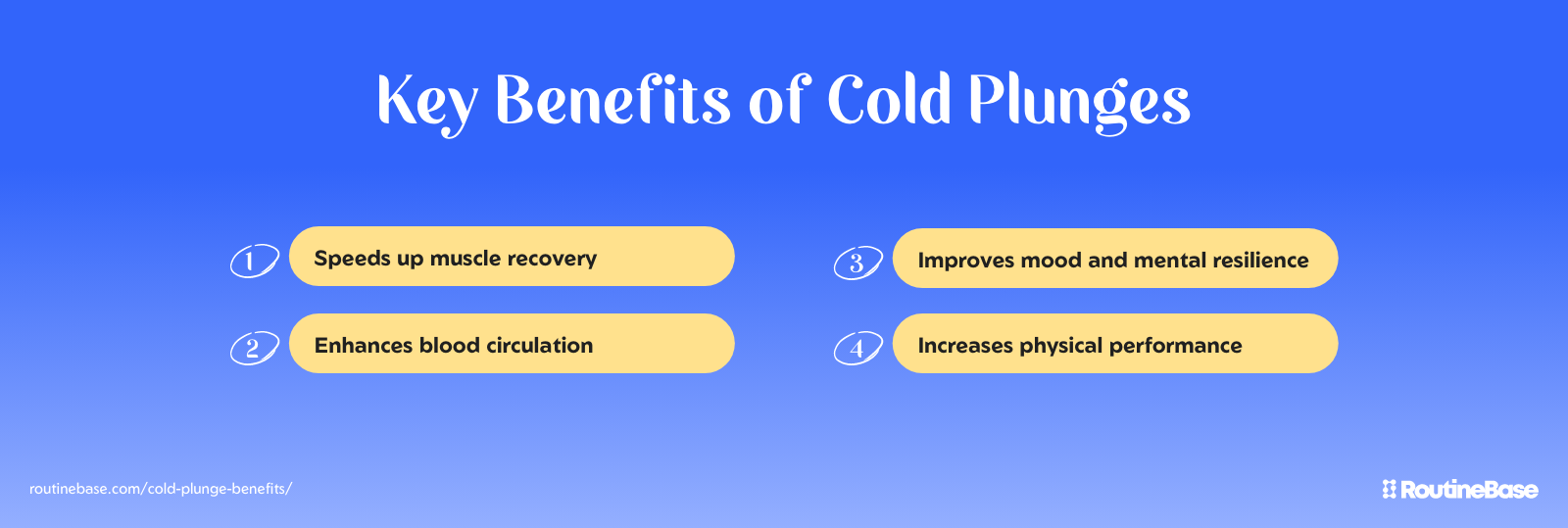
Graphic listing the key benefits of cold plunges.

Speeds up muscle recovery

According to a study that investigated the physiological stress experienced by athletes in tournament scenarios, cold water immersion improved sprint recovery and reduced muscle-damage markers and muscle soreness. For anyone training with real volume, the way you set up a post-workout ice bath, and when you use it relative to lifting, both affect how much of that recovery benefit you actually keep.

Alan also agrees that cold plunges speed up recovery:

The physical benefits of cold plunges are important. It's good for recovery, even though it's been shown that you shouldn't do cold plunges in super cold water for up to four hours after you do strength training because that doesn’t help with improving strength. So you should wait at least five, six hours before that, but it's good for recovery if you're not interested in getting the gains from the strength.

Enhances blood circulation

Like saunas, cold water immersion, a type of cryotherapy, is believed to improve blood circulation by constricting and dilating blood vessels. 

“It’s been shown to have some effect on improving the immune system, like blood flow, circulation, all these things,” says Alan. 

Improves mood and mental resilience 

This benefit is Alan’s favorite. He revealed that the primary reason he does cold exposure is for its mental health benefits. 

“The key thing is, essentially, I see cold immersion as a practice to improve mental and physical resilience. 

When you get cold, your whole body goes into a state of stress. You’re completely tense. I like to see it as a way of calming myself down in the midst of all of this stress, and then you can apply the same technique in your work or personal life to improve wellbeing,” says Alan. 

When you get random stressors coming at you from all directions, like a difficult meeting, for example. You can use the same technique that you use in the cold to calm yourself down, and that's essentially the main reason why I love it now, and it's kind of like a reset practice for me.

A study showed that cold exposure can increase dopamine levels in the short term, improving mood and reducing anxiety. 

Increases physical performance

Alan runs a lot and does some strength exercises two or three times a week. He revealed that cold showers and plunges improve his running performance and his overall body energy. 

“Even just taking cold showers for like three to five minutes helps my running performance. I noticed that I was able to run more often for longer, and I didn’t get injured as well since I started doing the cold showers and the river on the weekend.

Obviously, cold showers are different because the water is not even across the whole body, and then it’s warmer, definitely, than even the river, for example.

If you can only take cold showers, it can help to take them for longer, at least three to five minutes.

You feel lighter once you get out of the cold and more active, but also all the mental benefits like the mood and the energy. You get the compounding effects because if you feel better, if you have more energy, then you’re going to want to exercise more, and it’s sort of like a flywheel effect. So, I would say adding cold plunges to your physical activity routine can be very effective.”

Risks and Side Effects of Cold Plunging

Despite its important health benefits, cold plunging has some side effects and risks you should consider. 

Graphic listing the biggest risks of cold plunging.

Hypothermia

A common risk of cold plunging is hypothermia, which happens when your body temperature drops too low. 

Symptoms of hypothermia include intense shivering, confusion, and weak muscles. If you experience these symptoms during cold plunges, immediately get out of the cold plunge tub.

Alan also advises:

I would say the easiest way of knowing whether it's too much is when you start shivering, and you can't stop it anymore, even by (intentional) breathing. That's a good sign that you should probably get out.

Afterdrop 

Afterdrop is another side effect of cold plunges, and Alan explains how it happens and how to manage it:

“This is something that people should be really careful about. It’s called afterdrop. So basically, the cold blood in your limbs, like your extremities, flows back into your core.

When you get into the cold, all of your blood goes into the core to protect the vital organs, so that’s where most of the heat is. This is also why your hands and feet are going to be really cold because blood has flown into the core.

So what happens then with the afterdrop is once you get out, you’re going to feel very nice for a minute or two, but then what happens is that the cold blood that was in the extremities starts flowing back into the core and you can feel even colder sometimes than you were in the water.” 

It's very important once you get out to let your body warm itself up naturally by doing some movement instead of just drying up and putting your clothes back on like most people would do naturally.

Cardiovascular stress

Cold plunging can place significant stress on the cardiovascular system, especially for people with pre-existing heart conditions. 

The sudden drop in body temperature causes blood vessels to constrict, which raises blood pressure and increases the risk of heart attack or stroke. 

These potential risks and side effects of cold plunging should always be considered regardless of your current health condition. 

Talking to your doctor before starting cold plunges can help you understand the risks and determine if it’s a safe practice for you. 

How to Do a Cold Plunge

Since he’s been practicing cold plunging for many years now, Alan has some useful tips to share for those beginning this practice. 

These guidelines and techniques will help you safely and effectively perform a cold plunge.  

Graphic describing the three key steps of doing a cold plunge.

Preparation

The success or failure of your cold plunge practice depends mainly on what you do before jumping into the water. 

Here are some practical tips to help you prepare for cold plunging:

  • Do 2-3 minutes of deep breathing through your nose. Aim to expand your exhale to get into the parasympathetic mode, which decreases your heart rate. This will help you combat hyperventilation caused by cold shock once you get into the water.
I don’t just throw myself in the river. There are a few practices that you can do before you go in to warm up and to make sure that you produce heat, and then the other thing, the main thing, is controlling your breath, essentially while you're inside the water.
  • If you like visualizations, try picturing how you want to feel in the water. This will help you set clear intentions.  “Something that I’ve seen people do and that I’ve done a couple of times is visualization, actually visualizing yourself going through the cold and trying to feel the sensation before you go in,” he reveals.
  • Do some exercises to warm up your body before entering the ice water. “So make sure that you warm up the whole body, especially the bigger muscles in the legs and the core before you go in. There’s a warm-up practice, the horse stance, where you get down in a kind of […] a squat position, which helps keep the main muscles, the quads in the legs […] engaged as well as moving the whole core. What it does is to produce heat so that then you can use that heat to make it easier to be in the core while in the water,” Alan says.

Breath control

According to Alan, breathwork is the secret to successful cold plunging. 

“One problem might be if you can’t control your breathing and you keep breathing in, which can bring you into hyperventilation. What you should be doing instead is focusing on breathing out and making the exhale longer than the inhale. When we breathe in, the fight-or-flight nervous system is activated. When we breathe out, we activate the parasympathetic nervous system.

Parasympathetic is the rest-and-digest state, which is when we are, for example, after you have had a meal, that is the state you are in, so your body is completely calm, and you feel safe because you have food or whatever.”

So when you get into the cold bath, the key is to focus on breathing out and letting the air go out and relaxing the shoulders, neck, and everything else until you get to the point where the body produces a layer of thermal insulation. So you kind of feel like you're almost warm, that's if you stay still. So as soon as you move, the layer will go.

Move your body after getting out

When you immerse yourself in a low water temperature, the blood from your extremities goes to the core to supply the vital organs and protect them from the cold. 

That’s why, after you get out of the water, it’s essential to move your body to help restore warmth and improve circulation. 

You can try gentle exercises like light jogging, stretching, or dynamic movements to gradually raise your body temperature. 

Other Cold Plunging Tips 

We have some extra tips from Alan, who’s got years of experience doing cold plunges. 

Below, he discusses some challenges, best practices for beginners, and who should think twice before starting cold plunging. 

What was a big challenge you faced with cold plunges?

“I say the biggest challenge was for me that I have this thing called Raynaud’s syndrome, which has something to do with blood circulation in the hands, mainly in the limbs. So what happens is when I get cold, [blood in] […] my fingers essentially stops flowing. That’s been a challenge because I can’t feel my hands.

So, when I make cold plunges, I just keep my hands out, and that helps a little bit.

That’s a small price to pay. I can’t think of many other challenges.”

What practical advice would you give to someone new or about to start cold plunging?

I would recommend starting with (...) two minutes or three minutes. Slowly work your way up as you feel confident. This also depends on how cold the water or the ice bath is. Start gradually, so I just build up the tolerance because, at the end of the day, it's something that you build up.

“I’ll also say safety first. Never go into dangerous icy water and make sure that if you go into a river like I do, it’s safe. 

Something that can be helpful is to aim for discomfort instead of danger. So, you want some form of discomfort that will make you stronger or healthier in the long run. But don’t look for danger or do anything crazy or weird just to do it.”

Would you recommend this to a person who deals with stress or burnout?

“I would say it depends on how strongly burned out they are. If it’s something that’s not chronic or very bad, then I would probably recommend it because what you do is called hormetic stress. This is a controlled stress environment that trains you to understand that you have the power to deal with the stressor instead of just being a victim of whatever is happening to you. 

I do think that you need to be in a state where you can understand, you know, that’s something that you control because if you’re just in this spiral of burnout and everything, yeah, that’s probably not very good for you.”

Do you have any other advice for our readers?

The last thing I would say is to have fun. Cold plunging can be a bonding activity, you know, to go through stressors together. I did cold plunging with my mom and my aunt. They came to visit me in the UK. So I took them to the river, and my mom loved it.

Wrapping Up

Despite the hype and the often conflicting information available on cold plunges, our research and insights from an experienced cold-plunger give you a clear understanding of the practice. 

However, remember to always check with your doctor about whether it’s safe for you to take cold plunges. 

If you want to learn more about famous people’s routines and how to create consistent daily habits, check out our article base.

MEDICAL DISCLAIMER
The content provided on this website by RoutineBase OÜ is for informational purposes only and should not be considered medical advice. We are not healthcare professionals, and the information presented is not intended to diagnose, treat, or cure any medical conditions. Consult with a qualified healthcare provider before making any changes to your health or wellness routine.
AFFILIATE DISCLAIMER
Some of the links on this website are affiliate links, meaning RoutineBase OÜ may earn a commission if you click through and make a purchase at no additional cost to you. The inclusion of any affiliate link does not imply endorsement, approval or control by RoutineBase OÜ of the site. Use of any such linked site is at your own risk and we strongly advise you make your own investigations with respect to the suitability of those sites.